
Leading through transition: what changes when you stop managing a function and start leading people
There is a particular kind of discomfort that many leaders will recognise but few talk about openly.
You have been promoted into a significantly more senior role. The people who promoted you did so because of what you have delivered — your results, your judgment, your reliability. You have been excellent in the work you have done. The promotion is deserved.
And yet, several months in, something feels off. The skills you relied on are less relevant than they were. The conversations you are having are less familiar. The feedback loops you used to have — the clear metrics, the visible deliverables, the sense of completion at the end of a project — are murkier. You find yourself managing dynamics rather than tasks. Navigating ambiguity rather than solving problems. Influencing without authority in ways that feel less certain than the authority you used to have.
This experience is so common that it has a name in coaching literature. But naming it does not necessarily make it easier to navigate. Because the discomfort feels personal — like a deficit, like you are not quite equal to the role you have been given.
In my experience, that feeling is almost never accurate. It is, however, almost always a signal that a real transition is underway.

The gap between being excellent at what you did and being excellent at what you are now asked to do is a genuine gap. But it is not a character gap. It is a skill gap — and those close with honest work.
What actually changes when the role changes
The clearest way I can describe the shift is this: in most functional leadership roles, your excellence is visible in what you produce. In a senior leadership role, your excellence is increasingly visible in what others produce.
This sounds simple. In practice, it requires a fairly fundamental reorientation of where you focus your attention, how you measure your contribution, and what you allow yourself to do directly versus what you enable in others.
There are three specific areas where I see this transition get difficult most consistently.

From solving to creating conditions
In a functional role, being a good problem-solver is one of the most valued things you can be. Problems arrive, you address them, and your credibility is built from that track record.
In a senior leadership role, the better move is almost always to create conditions where problems get solved by the people closest to them. Which means tolerating a slower resolution in the short term, watching someone navigate something imperfectly, and not stepping in when you could technically solve it faster yourself.
Most high performers find this extremely uncomfortable at first. I have heard it described as standing with your hands tied behind your back. What changes that experience is when the leader starts to see the difference between solving a problem once and building a team that solves problems reliably. The second is a much bigger contribution. It just does not feel like one while you are learning how to make it.
From managing tasks to reading people
The work of senior leadership is fundamentally relational. Not in a soft sense — in a practical one. Your effectiveness depends on your ability to read what is really happening in your team, across your peer group, and upward. Who is struggling. What is not being said. Where the energy in the room is actually going versus where it appears to be going.
This requires a kind of attention that is different from the attention required to manage a project. It is slower, more qualitative, harder to structure. It requires being comfortable sitting with ambiguity and not immediately moving to resolution.
I often find that leaders who have been promoted because of their analytical sharpness find this the most disorienting. They are very good at processing information efficiently. The information that matters most in senior roles — the relational, emotional, political — does not process in the same way. It has to be felt before it can be understood.
This is where emotional intelligence stops being a soft skill and starts being a core leadership competency. Not because it is morally important to be empathetic, but because without it you are operating on incomplete information about what is actually happening in your organisation.
From having answers to asking the right questions
In most technical and functional roles, having good answers is what distinguishes you. Being the person who knows builds credibility.
In senior leadership, being the person who asks the right question often has more leverage than having the right answer. The right question surfaces things that would not otherwise become visible. It creates space for the people closest to a problem to contribute what they know. It signals intellectual humility in a way that builds trust rather than competitiveness.
This does not mean pretending not to know. It means being genuinely curious about what others see before forming a view. The leaders I have worked with who make this transition most successfully are the ones who start to feel the difference between the weight of an answer they have formed alone and the resilience of a direction that has been genuinely shaped by many perspectives.
What helps during a leadership transition

I want to be specific here, because general advice about transitions tends to be unhelpfully abstract.
Name what you have lost, not just what you have gained
Promotions are framed as gains. And they are. But they also involve real losses — proximity to the work you were good at, the clarity of well-defined deliverables, the feedback loops that told you where you stood. Naming those losses honestly is not complaining. It is a prerequisite for grieving them efficiently and moving on.
Leaders who do not name what they have lost often spend years trying to reclaim it — staying too close to the work, micromanaging, solving problems that should not reach them. The transition completes more cleanly when both sides of it are acknowledged.
Find a space where you can be genuinely confused
The thing that makes leadership transitions hard is that there is usually no safe place to not know. You are expected to be leading. The people around you are looking to you for direction. Admitting confusion feels like the wrong signal to send.
Which is why the leaders who navigate transitions most effectively almost always have some form of external support — a coach, a mentor, a trusted peer outside the organisation. Not to be given answers, but to have a space where the real experience of the transition can be processed honestly.
I have seen leaders carry three years of silent confusion through a transition that a few honest conversations could have shortened considerably. The cost is not just personal. It is organisational. Confused leaders who cannot be confused out loud make worse decisions and create more uncertainty in their teams than they realise.
Start measuring yourself differently
One of the most practical shifts a transitioning leader can make is to change what they track. Not the KPIs their organisation sets — those matter. I mean the internal metrics: what they pay attention to, what they feel good about at the end of a day.
If those metrics are still the same as in the previous role — tasks completed, problems solved, decisions made — the transition has not fully landed. The new metrics feel more diffuse at first: a conversation that opened something up, a team member who handled something they could not have handled six months ago, a difficult dynamic that shifted because of how you showed up in a room.
These do not appear in dashboards. But they are the actual work of senior leadership. When a leader starts tracking them, something changes in how the role feels — and in how they perform in it.
A final thought
Every senior leader I have worked with who has navigated a transition successfully has said a version of the same thing on the other side: I wish someone had told me earlier that the discomfort was not a sign that I was failing. It was a sign that the transition was real.
The discomfort is information. Not about whether you are equal to the role — about the fact that the role is genuinely different from what you have done before. That is the point. And the work of navigating it is not about performing the new role more convincingly. It is about actually becoming the leader it requires.
That is inside-out work. It always is.
If this piece resonated with you, here is where the work continues.
I am an ICF PCC certified executive coach, facilitator, and leadership thinking partner based in Pune, India. With 27+ years across organisations including Tata Motors, Ma Foi, and Principal Financial, and 1000+ hours of coaching conversations, I work with senior leaders and HR professionals who are ready to do the deeper work of leading from the inside out.
My Offerings
Executive and Team Coaching — A six-month, non-directive coaching engagement for leaders navigating transitions, complexity, or a growing sense that something needs to shift.
Mentoring — Structured, goal-anchored mentoring for professionals navigating career transitions, stepping into leadership, or seeking direction from someone who has been in the room.
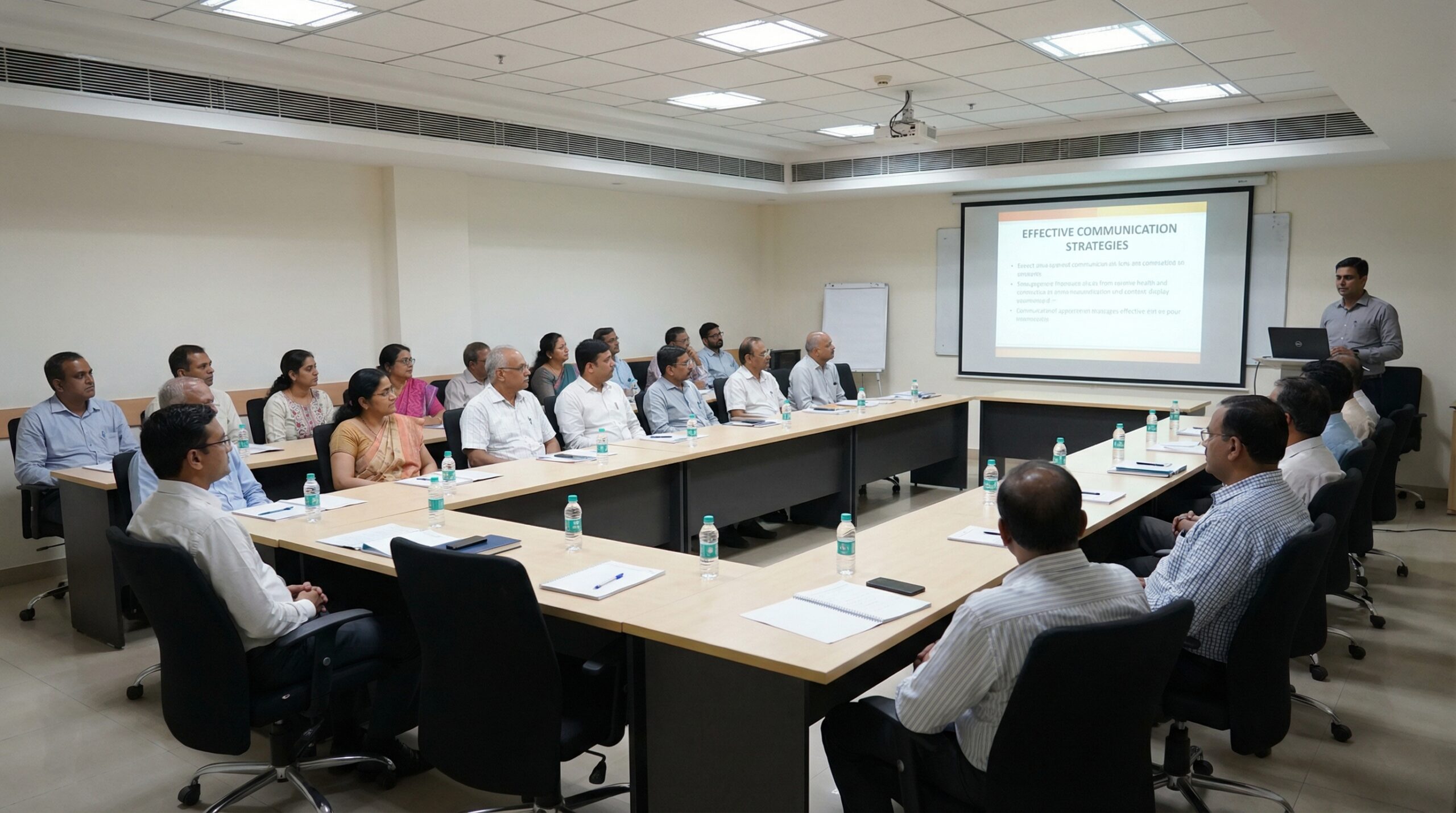
Leadership Training and Facilitation — Customised, journey-based programmes for organisations delivered through Attrans Management Solutions, across areas including Emotional Intelligence, Change Readiness, Ownership & Accountability, and Team Behaviour.
If any of this feels relevant to where you are right now, the first conversation is always a discovery call — complimentary, honest, and without pressure. Book your appointment now!
Recent Posts

Why does most leadership development not stick ?
April 1, 2026

When high performance becomes a trap
April 1, 2026
What Changes While Leading through transition
April 1, 2026